
On April 11, Artemis II returned to Earth, marking the first crewed mission to travel beyond Earth’s orbit in more than fifty years. What made it truly remarkable was not only the distance covered, but the exceptional prominence of women throughout the mission. To begin with, it bears the name of one of Olympus’ great deities—the goddess of nature, animals, and the hunt, and twin sister of Apollo.
Artemis II has set a new record: it is the mission that has carried human beings farther from Earth than any other since the Apollo era. Its four crew members traveled beyond low Earth orbit to the far side of the Moon, in the first crewed mission of such scope since Apollo 17. Yet the distance measured in kilometers is not the only parameter that defines the magnitude of this moment. There is another, less quantifiable yet more meaningful: the distance advanced in terms of rights.
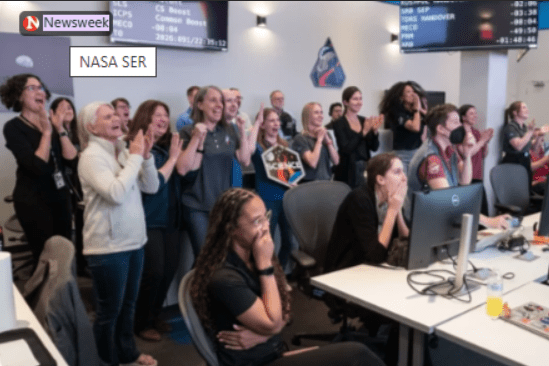
Indeed, on April 6, an image went viral that spoke louder than any official statement from Houston. In the Science Evaluation Room at the Christopher C. Kraft Jr. Mission Control Center, a group of women gathered at the control consoles celebrated the successful completion of Artemis II’s lunar flyby. They were responsible for the scientific planning and execution of the mission. The euphoria on their faces was not merely professional—it was also historical for women. Decades ago, such an image would have featured only white men.
Artemis II ushers in a new era in space missions
The Apollo era was a scientific triumph driven almost exclusively by white men. Not because women were absent—they were present, and their contributions were decisive—but because their work was systematically rendered invisible. With Artemis II, female talent has gained long-overdue visibility. Approximately 35% of NASA’s technical, scientific, and leadership positions are now held by women. Many of the highest operational roles are occupied by women, and the 2025–2026 astronaut candidate class is the first in history to have a female majority: 60%.
Women’s active participation at NASA is the natural outcome of the professional trajectories of brilliant, tenacious, and exceptionally well-prepared women, as well as the result of feminist struggles that claimed their rights—struggles in which NASA’s own scientists and engineers took part, paving the way for those who followed.
The leaders of Artemis II
Christina Koch, an astronaut, physicist, and electrical engineer, serves as a mission specialist on Artemis II. Among the four crew members, Koch holds a distinctive position. Her presence is not symbolic; it is the logical consequence of an outstanding scientific career built upon exceptional technical expertise in a field where, only decades ago, women were simply not welcome.
Koch was selected by NASA in June 2013 as part of Astronaut Group 21, completing her basic training in 2015. Her first mission was an expedition to the International Space Station (ISS), where she spent 328 consecutive days in space (2019–2020), setting the record for the longest single spaceflight by a woman, surpassing Peggy Whitson. During that expedition, she conducted six spacewalks (EVAs), totaling more than 42 hours outside the station. Among them were the first three all-female spacewalks in history, carried out alongside astronaut Jessica Meir.
Vanessa Wyche, an African American engineer with an extensive record of professional achievements, is the Director of the Johnson Space Center, the central hub of NASA’s human spaceflight operations, where astronaut training and mission control are managed.
Charlie Blackwell-Thompson, an engineer, is Artemis Launch Director and the first woman in NASA’s history to hold this position. Under her authority, the decision to launch Artemis II was made, following the success of Artemis I, which she also directed. She has spent decades at the Kennedy Space Center, breaking a glass ceiling that had remained intact since the agency’s founding in 1958. It was she who gave the “GO!” for the Artemis II liftoff.
Diana Trujillo, Flight Director at Houston Mission Control, is a distinguished Colombian aerospace engineer. From Houston, she oversaw the mission in real time. Her career is also the story of an extraordinary migrant woman from Latin America: she reached the pinnacle of aerospace engineering after arriving in the United States without speaking English, yet determined to become an engineer, funding her studies by working as a cleaner.
Sharon Cobb, an engineer responsible for the Space Launch System, led the management, planning, and logistics team required to ensure the rocket’s design and construction. She is responsible for ensuring that all components of the SLS program align and deadlines are met. Her team built the most powerful rocket ever developed by NASA—the same rocket that made Artemis II possible.
Laura Poliah, lead engineer, headed the Orion spacecraft test execution team for Artemis II, without which the mission could not have been carried out. Her team subjects the spacecraft to extreme conditions—vibrations, vacuum, and temperature—to simulate space and ensure mission success.
Teresa Nieves-Chinchilla, a Spanish physicist and Director of Space Weather at NASA, focuses her work on predicting and monitoring solar behavior to ensure astronaut safety during long-duration missions, given the risks posed by solar radiation.
Nicola Fox, a physicist and Associate Administrator for NASA’s Science Mission Directorate, holds the agency’s highest scientific position. She was the lead scientist on the Parker Solar Probe mission, the probe that “touched” the Sun.
Liliana Villarreal, a Colombian aerospace engineer with a distinguished career at NASA, serves as Director of Landing and Recovery for Artemis II. She coordinated the Pacific Ocean recovery operation to retrieve the crew and the Orion capsule after splashdown—the final phase of the mission, where no margin for error exists.
Laurie Leshin, a renowned geochemist and space scientist with extensive experience leading engineering and space research institutions, has focused her scientific work on the search for water and life in the solar system, contributing to key instruments on the Curiosity rover on Mars.
Angela Garcia and Kelsey Young, the first certified science officers of Artemis II, were responsible for planning and executing lunar scientific research from mission control. They coordinated operations from the Science Evaluation Room during the April 6 lunar flyby.
The pioneers who paved the way
The prominence of these women—and many others—in Artemis II is not only a technological leap; it is also an achievement owed in part to the pioneers who came before them. Among them are Soviet cosmonaut Valentina Tereshkova, the first woman in space (1963), who completed 48 orbits of Earth over nearly three days and remains the only woman to have flown solo; Sally Ride, the first American woman astronaut; and Svetlana Savitskaya, the first woman to perform a spacewalk (1984).
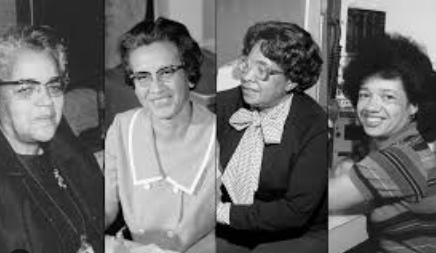
Equally significant are the four legendary mathematicians of the Apollo program—the “human computers”—whose contributions were decisive in ensuring the safe return of the Apollo 11 crew after the Moon landing (1969).
Katherine Johnson, an African American physicist, mathematician, and space scientist, played a crucial role in U.S. aeronautics and space programs. She manually calculated the orbital trajectories for Apollo 11 with remarkable precision. Her mathematical talent was so extraordinary that, before trusting computers, John Glenn required that the data for his Mercury-Atlas 6 mission (1962) be calculated and verified by her.
Dorothy Vaughan, a mathematician and the first African American woman to lead a team at NASA, anticipated the digital transformation of the agency. When IBM computers were introduced and many mathematicians feared obsolescence, she taught herself the programming language Fortran and trained her entire team.
Mary Jackson, NASA’s first African American aerospace engineer, had to obtain a court order to attend engineering courses at a segregated university in Virginia. She graduated with honors and later dedicated her career to ensuring that other women would not have to seek permission to study or work where they wished, leading internal programs that opened doors for future generations.
Christine Darden, an African American aeronautical scientist and one of NASA’s “human computers,” made significant contributions to supersonic flight research, becoming a key figure in aerospace innovation.
Johnson, Vaughan, Jackson, and Darden broke barriers that seemed insurmountable, making decisive contributions to the space race at a time when African Americans faced severe restrictions. They worked within an androcentric and racially segregated institution, where Black women entered NASA buildings through separate doors, used segregated facilities, and ate in separate dining areas. This tribute also extends to Artemis II pilot Victor Glover, the first African American astronaut to take part in such a mission.
What we owe to feminism
The increasing presence of women in technical and scientific leadership roles at NASA demonstrates that when structural barriers preventing women’s access to education, institutions, and positions of responsibility are removed, the result is a stronger, more diverse, and ultimately better mission—one that more accurately represents humanity.
Today, 35% of NASA’s civilian scientific and technical workforce are women. Yet it must not be forgotten that fifty-two years ago, at the time of the last Apollo mission (1972), the Second Wave of feminism was at its peak, and women in the United States were still fighting for full rights—particularly in relation to gender-based violence, sexual and domestic violence, reproductive rights, divorce, education, political representation, economic autonomy, and the inclusion of Black and migrant women.
During that transformative decade of the 1970s, historian Gerda Lerner began writing The Creation of Patriarchy, analyzing the system of oppression constructed to subordinate women and perpetuate inequality—a system that remains in place today.
Artemis II does not resolve the structural causes of inequality that women and girls continue to face. However, it demonstrates, with undeniable clarity, what women are capable of achieving when obstacles are removed. For this reason, the achievements of Artemis II provide yet another opportunity to recognize and thank all the women who made it possible—that is, feminists and feminism itself. As the renowned lawyer and politician Lidia Falcón, president of the Feminist Party of Spain, has stated: all the rights women have today are owed to feminism and to feminists.


Deja una respuesta